blog
Digital Transformation Trends Defining the Business Landscape in 2026
Digital transformation January 9, 2025

Digital transformation spending is massive, aimed to reach around $3.4 trillion in 2026, but the mood inside companies has changed. Leaders are less excited about shiny pilots and more focused on what actually shows up in results, which is why about 25% of enterprises have pushed planned AI spend to 2027.
The gap between vendor promises and real balance sheet impact is real, and many teams are choosing to build quietly: AI that is embedded into workflows, measured like any other business investment, and guided by human judgment, restraint, and clear priorities.

1. Agentic AI Becomes the Operating Layer
In 2026, the "assistants" of the past have evolved into a sophisticated Silicon Workforce. We have moved from "user-centric" design, where humans use tools, to "process-centric" design, where autonomous multi-agent systems execute complex, multi-step workflows with minimal oversight.
“Gartner projects that 40% of enterprise applications will incorporate task-specific AI agents by the end of 2026.”
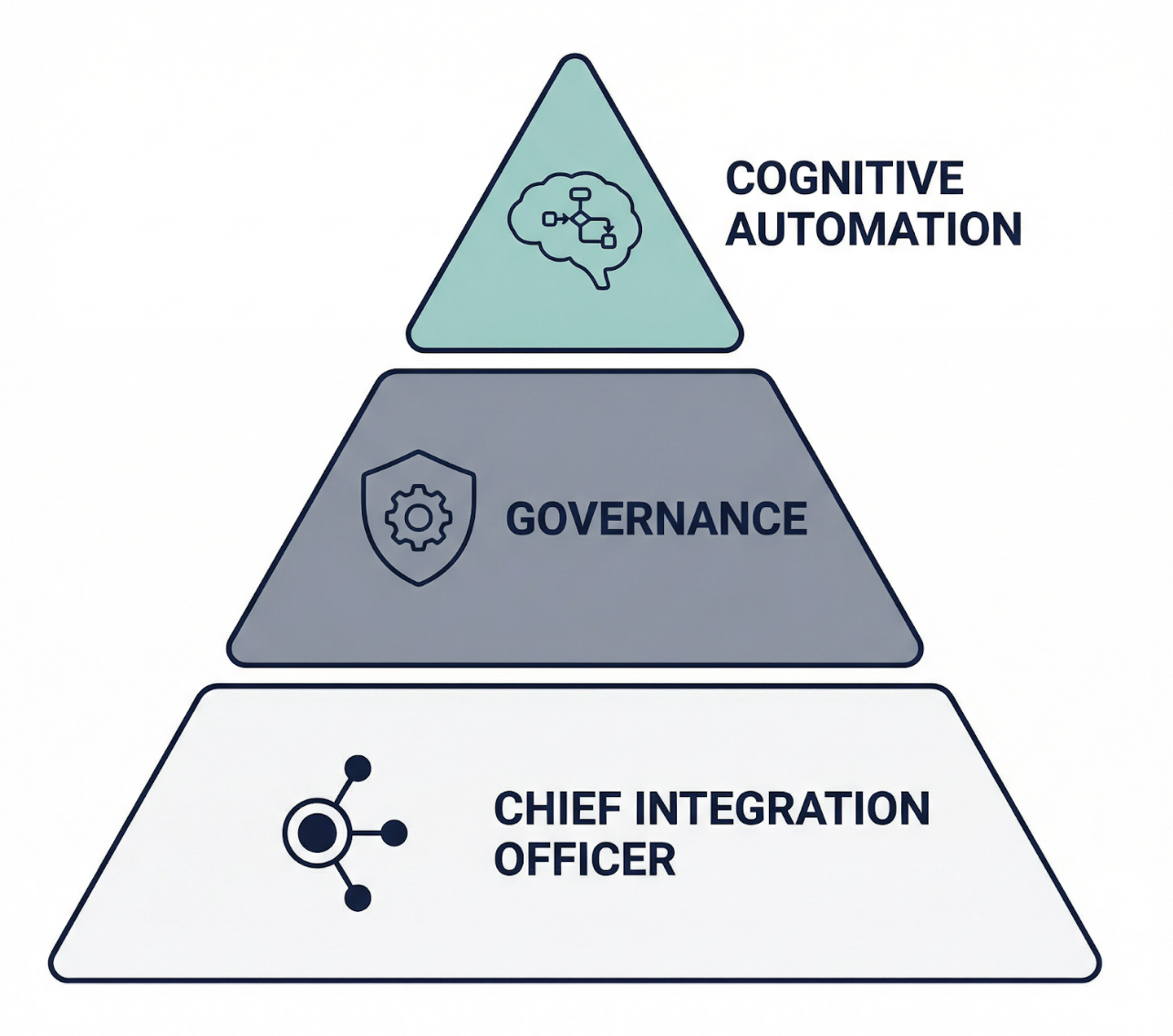
Agentic AI as an operating layer requires a shift from task automation to cognitive automation, where agents reason, plan, and act dynamically. To manage this autonomy, organisations must adopt governance-as-code, embedding compliance and security directly into agent workflows. As a result, the CIO role evolves into a Chief Integration Officer, overseeing orchestration across the agentic ecosystem rather than individual systems.
Agentic AI is already being deployed across core operational systems. In telecom, operators use agentic architectures for self-healing networks, autonomous provisioning, and predictive maintenance, with Airtel applying them for real-time optimisation and workflow automation. In manufacturing and retail, agents coordinate end-to-end workflows such as inventory management, purchase order adjustments, customer service handling, and operational documentation. In HCM, organisations are beginning to manage AI agents as digital employees within existing workforce platforms.
2. Software Becomes AI Native by Default
Software is moving away from isolated “AI projects” and toward invisible, always on infrastructure. AI works best when users barely notice it. Today, 34% of organizations prefer embedded AI inside ERP and CRM tools, compared with 19% using standalone AI apps. When intelligence is built into the workflow, adoption rises because there is nothing new to learn.
What changes in practice
Embedded AI becomes the default: insights, predictions, and automations show up inside the tools people already use.
Domain specific language models: smaller models tuned to a single function (finance, support, supply chain) deliver faster, cheaper, more reliable results for specific workflows.
Architecture is shifting to process-centric systems where MCP enables secure, cross-platform agent workflows for 30% of vendors. Simultaneously, autonomous ERP governance embeds real-time compliance and explainable controls directly into mission-critical transactions.
Strategy and Competitive Reset
This shift forces a broader operating model upgrade. Many cloud first stacks are not designed for the speed and economics of AI at scale, pushing organizations toward modular architectures plus embedded governance.
What it triggers: The Great Rebuild mandates a stack overhaul for always-on AI execution to compete with high-efficiency, AI-native startups. Meanwhile, Sovereign AI momentum will drive 75% of EMEA enterprises into local clouds by 2030 to satisfy rigorous residency and control requirements.
3. The Infrastructure Reckoning: The Age of Inference Economics
The industry is grappling with the "Inference Inversion." By 2026, the volume of tokens used for running models (inference) has officially exceeded those used for training. This has forced a pivot from cloud-first to "strategic hybrid" compute models.
While "Edge AI" remains a popular buzzword, the reality is that the vast majority of inference still occurs in data centers using power-intensive chips worth over $200 billion. To survive this, leaders have moved from PUE (Power Usage Effectiveness) to PCE (Power Compute Effectiveness)—measuring intelligence output per watt.
The Consultant’s Insight: The 90/10 SLM Rule Forward-thinking organizations are slashing costs by deploying Small Language Models (SLMs). These models provide 90% of the performance of frontier models at only 10% of the cost, allowing for private, fine-tuned, and domain-specific assets that de-risk the supply chain.
4. Security Shifts from Defense to Architecture
Security in 2026 shifts from perimeter defense to built in architecture. Threats move at machine speed, so the baseline becomes identity first design: strong MFA and passkeys, least privilege access, and micro segmentation, with controls embedded into how systems are built and run. At the same time, security roadmaps expand for quantum risk, with organizations beginning their first move toward post quantum cryptography to protect long life data from harvest now, and decrypt later attacks.
What changes
Preemptive protection: AI driven SecOps predicts and blocks threats before impact, and preemptive approaches are projected to take nearly half of security spend by 2030.
Security as code: Governance and compliance rules are codified to control autonomous agents, with explainability, audit trails, and misuse detection built into AI pipelines.
Supply chain and data integrity: SBOMs, signed artifacts, runtime integrity checks, confidential computing (TEEs), and early PQC migration planning protect provenance and data in use.
Platform consolidation: Organizations reduce tool sprawl by unifying identity, endpoint, and data security, then prove resilience with outcome SLAs like MTTD and MTTR.
5. Selective Consumption: The Competitive Advantage of Restraint
Consumers are no longer passive targets; they are intentional filters. Exposed to 10,000 marketing messages daily, the public has moved toward "Helpful Restraint."
Volume-based metrics have become a liability; 70% of consumers have unsubscribed from brands recently due to overwhelming message volume. The new imperative is knowing when not to communicate. Furthermore, as data privacy tightens, Synthetic Data has emerged as a strategic weapon. By creating "synthetic realism" at scale, brands can train systems and model behaviors without infringing on consumer privacy or facing data scarcity bottlenecks.
The Human Paradox of 2026
The "Reality Check" of 2026 has revealed a profound paradox: as our technology becomes more autonomous and invisible, our human proof points become more valuable.
Organizations are no longer just hiring for technical skill; they are architecting new roles like the Agent SRE (Site Reliability Engineer for agents) and the Chief Agent Officer. The question for your leadership team is no longer "How do we automate this?" but "How do we redesign for an AI-native future?" The window for this transformation is open, but it rewards only those who move with intention, prioritize trust, and understand that in an automated world, humanity is the ultimate differentiator.